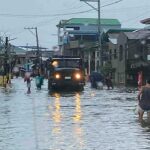

The Department of Education (DepEd) has activated its 4H emergency learning protocol as heavy rains brought by the Southwest Monsoon, or Habagat, disrupted classes in Metro Manila and several provinces.
DepEd said schools should use its 4H protocol — Hinto (Stop), Hinga (Breathe), Hinay (Slow Down), and Hayo (Move Forward) — to determine the appropriate mode of learning based on safety, learner readiness, available resources and local conditions.
Under the protocol, schools may suspend, ease, adjust or resume learning activities depending on safety conditions, learner readiness and available resources.
Education Secretary Sonny Angara said the framework is designed to prevent schools from adopting a one-size-fits-all approach during emergencies.
“When the rain is heavy, roads are flooded, or the safety of learners and teachers is at risk, there cannot be a one-size-fits-all decision. The basis must be clear: Is it safe? Is it manageable? And what kind of learning support is appropriate?” Angara said.
DepEd reminded schools and field offices to implement its Education in Emergencies framework to ensure the safety of learners, teachers and other school personnel while allowing learning activities to continue when conditions permit.
The protocol is laid out under Memorandum Circular No. 123 issued by the Office of the President, which directed the use of alternative learning modes in affected areas on Monday unless otherwise ordered by local chief executives.
What does the 4H protocol mean?
“Hinto” applies when conditions are unsafe or when the safety, protection or basic needs of learners are at risk. Academic activities are temporarily suspended so schools and communities can prioritize safety, emergency response and essential support.
“Hinga” is used when learners, teachers and school personnel need time to recover from stress, disruption or displacement. Schools may conduct well-being checks, provide psychosocial support and offer light asynchronous activities, but regular academic requirements and submissions should not be required.
“Hinay” applies when there is disruption but learning can continue in an adjusted, teacher-supervised manner. Schools may use synchronous or asynchronous learning depending on connectivity, available resources and local conditions.
“Hayo” is activated once conditions return to normal and regular learning can safely resume.
DepEd said schools that have shifted to asynchronous or other alternative learning modes because of the current rains may classify these arrangements as Hinay, provided that learners and teachers remain safe and learning requirements are adjusted to the situation.
The department stressed that ensuring learning continuity during emergencies does not mean requiring students and teachers to continue regular academic work despite unsafe or highly stressful conditions.
“In times like these, safety must come first. Some situations require us to ‘Hinto,’ some call for ‘Hinga’ to recover, while others can adopt ‘Hinay’ through adjusted learning. Schools can return to ‘Hayo’ once conditions return to normal,” Angara said.
Schools were also directed to coordinate with local government units, disaster risk reduction and management offices, and DepEd field offices in determining the appropriate level of learning continuity.
They were reminded to update their Learning and Service Continuity Plans, maintain emergency communication channels with learners and parents, and ensure that academic requirements remain reasonable during weather-related disruptions.
DepEd regional offices and schools division offices will continue to provide technical assistance to schools in areas affected by heavy rains, flooding, landslides and other hazards.
Through the 4H protocol and other learning continuity measures, DepEd said it aims to help schools make timely, context-sensitive decisions that prioritize the safety and well-being of learners and teachers while allowing learning to continue whenever conditions permit. — MCG, GMA News