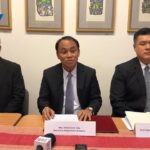

THE Philippine Atmospheric, Geophysical and Astronomical Services Administration-Davao Region (Pagasa-Davao) is planning to establish weather monitoring stations in Davao Oriental, a province that was heavily battered by Typhoon Pablo (International name, Typhoon Bopha) in 2012, to improve localized forecasting and disaster preparedness.
Among the areas being considered is the municipality of Tarragona, which is located far from the existing Pagasa radar and synoptic station in Hinatuan. Other municipalities being eyed include Boston, Baganga, Caraga, and Manay.
Engr. Alan Ray Ribo said this during a four-day Climate Impact and Environmental Reporting Workshop for Journalists in Mindanao held from April 24 to 27, 2026 in Mati City, where he discussed weather literacy and climate science.
“We are planning to establish a weather station soon in Davao Oriental because we only have a few stations here,” Ribo said.
Ribo said Pagasa-Davao has proposed the construction of at least one synoptic weather station in the province, with several municipalities identified as possible sites. The proposal was submitted to the Regional Disaster Risk Reduction and Management Council (RDRRMC) in 2025 and has already been approved.
The project is estimated to cost between ₱20 million and ₱25 million, covering land acquisition and the installation of meteorological equipment.
A synoptic station is a surface-based facility that measures key atmospheric elements such as rainfall, temperature, wind speed and direction, and air pressure — data essential for accurate weather forecasting, according to Pagasa.
Ribo said the cost could be reduced if local government units donate land for the facility.
He said additional stations would allow the province to generate its own weather data, improving forecast accuracy.
“When it comes to weather forecasting, a province should be able to provide their pressure level, wind direction, wind speed, and other weather parameters,” he said, noting that relying on data from neighboring areas results in more generalized forecasts.
At present, Pagasa operates two major weather monitoring facilities in the Davao Region: a flood forecasting and warning center in Tagum City and a weather station in Davao City.
Davao Oriental’s push for improved weather monitoring comes more than a decade after Typhoon Pablo struck eastern Mindanao. The typhoon made landfall in the province on December 4, 2012, unleashing strong winds and heavy rains that triggered deadly floods and landslides, leaving thousands dead and widespread destruction across several municipalities.
The planned expansion is expected to strengthen early warning systems and help communities better prepare for future extreme weather events. DEF