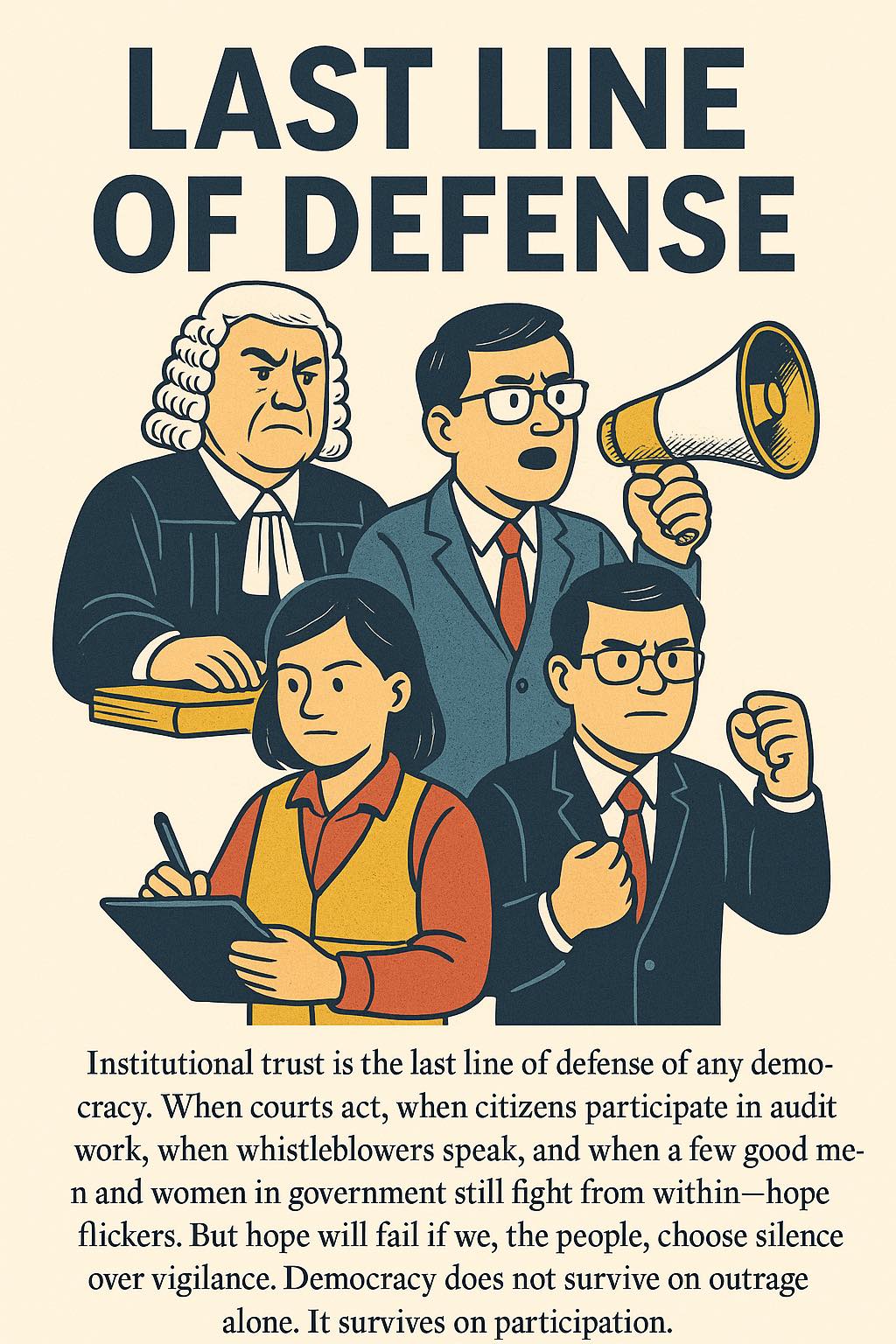

SOCIOLOGIST RANDY David has long warned us that what truly holds a society together is not brute force, nor even economic growth, but something far more fragile and invisible: institutional trust—the belief that our systems of governance, law, and accountability, however imperfect, still work fundamentally for the common good. Once that trust collapses, societies can unravel with frightening speed. The danger is no longer just bad government; it is the normalization of cynicism, withdrawal, and despair.
That warning now feels painfully close to home.
In his recent column, “Managing transitions: EDSA to Bangladesh,” David reminds us that political transitions, no matter how dramatic, do not automatically result in justice or reform. Everything depends on whether institutions survive the transition with enough credibility—and whether citizens remain engaged enough to demand that those institutions do their work. It is this double fragility—of institutions and of citizens—that now places our democracy under real strain.
The recent ruling of the Supreme Court of the Philippines declaring the diversion of PhilHealth funds unconstitutional was therefore more than a legal technicality. It was a moral event. It affirmed that even amid systemic decay, constitutional guardrails still stand. For many Filipinos reeling from repeated corruption scandals, the ruling came as a restrained reassurance that the rule of law has not entirely collapsed. And yet, it also confirmed the gravity of the betrayal: billions meant for the sick and vulnerable had been treated as negotiable political currency.
Alongside this, the patient investigative work of the Independent Commission on Infrastructure (ICI) continues to unfold—despite its lack of subpoena powers or prosecutorial authority. Its value lies precisely there: it represents truth-seeking that depends not on coercive power but on evidence, persistence, and public credibility. It shows that even from the margins, accountability can be pursued.
Equally significant are the initiatives of citizens’ groups now partnering with the Department of Public Works and Highways for participatory audits and ground validation of infrastructure projects. Ordinary citizens—engineers, professionals, youth volunteers, parish groups—are now inspecting road thickness, photographing sites, documenting “ghost projects,” and comparing what exists on the ground with what appears on paper. This is democracy returning to its most basic form: the people watching over their money.
Meanwhile, the Office of the Ombudsman of the Philippines has begun preparing charges against those implicated by documentary evidence. These moves matter not only for their eventual legal consequences but for their symbolic force: they signal that institutions are still capable—at least in principle—of self-correction.
Taken together, these developments help balance public unrest and moral outrage with a fragile but real measure of institutional trust. They also remind us that there are still a few good men and women within government who are doing their best to make democracy work—often quietly, often under pressure, often at personal risk.
Yet this same period has also exposed how fragile institutional momentum can be.
In October 2025, then–Justice Secretary Jesus Crispin Remulla—who had publicly declared that hundreds could be indicted for anomalous infrastructure projects—was abruptly transferred from the Department of Justice to the Ombudsman. For a time, the DOJ was placed under interim leadership, and even after a new secretary was confirmed, the transition inevitably disrupted continuity. Case-building, consolidation of evidence, coordination among prosecutors—all these processes depend not only on legal authority but on institutional stability.
At precisely the moment when sustained momentum was most needed, the legal machinery had to recalibrate. This is not merely a bureaucratic inconvenience. It is an institutional vulnerability. When leadership shifts repeatedly in the middle of high-stakes investigations, even the best intentions can be undermined by delay, miscoordination, or loss of institutional memory.
Another troubling dimension remains the situation of the whistleblowers—among them Brice Ericson Hernandez, former Assistant District Engineer of the DPWH Bulacan 1st District, and Jaypee Mendoza, former DPWH engineer—whose early disclosures reportedly triggered wider revelations that later pressured senior officials to testify. Public records indicate that they are under the government’s Witness Protection Program, but not yet granted full state-witness status.
This legal ambiguity matters. Because nothing shapes the future of accountability more than how the first truth-tellers are treated. If whistleblowers remain protected only in a limited or conditional way—despite their willingness to make full disclosure, plead guilty, and pledge restitution—then the message to future insiders is deeply unsettling: telling the truth may still cost you everything.
This is where the deeper problem of institutional trust reveals itself most sharply. Trust does not collapse only because of corruption. It collapses when people see that truth-telling is unsafe, that justice is uneven, that accountability is episodic rather than systemic.
And yet, we must also acknowledge the other side of this tension. These institutional efforts—court rulings, civil-society investigations, participatory audits, Ombudsman actions—will all fail to deliver lasting results without stronger and more assertive citizen participation. The few good men and women in government cannot carry the entire moral burden of the republic.
Democracy does not survive on goodwill alone. It survives on pressure—lawful, organized, sustained pressure from citizens who refuse to let public memory fade and public attention drift.
One of the most dangerous temptations in moments like this is withdrawal. People grow weary. They grow cynical. They retreat into private survival. They say, “Pare-pareho lang sila.” But that is precisely how institutional decay becomes permanent. When citizens disengage, corruption ceases to be a scandal and becomes a system.
Randy David’s insight is therefore decisive: institutions can only rebuild trust when citizens remain active participants in their reform. Institutional trust is not blind faith in authority. It is confidence earned through vigilance.
The Supreme Court can act. The Ombudsman can file charges. The DOJ can prosecute. But only citizens can sustain the moral climate where these actions are demanded, monitored, and defended from political interference. Only citizens can ensure that transitions do not become excuses for amnesia.
What we are facing today is not merely a crisis of corruption. It is a crisis of continuity—of whether our institutions will be allowed to complete the work they begin, and of whether our people will stay engaged long enough to insist on outcomes, not just announcements.
We are not yet at the point of collapse. But neither are we safely beyond the danger. The signs of institutional life are still there—but faint, contested, and fragile.
In the end, institutional trust will not be restored by rhetoric alone, nor by isolated victories. It will be rebuilt only when citizens themselves refuse to settle for half-measures—when they accompany investigations, monitor public works, defend whistleblowers, demand prosecutions, and vote not out of anger alone but out of sustained moral clarity.
That is the last line of defense of any democracy.
And that defense, finally, rests not in courts or commissions alone, but in the people themselves.